We tend to assess the severity 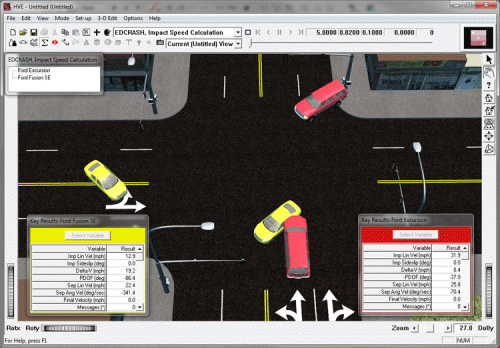
Suppose then that two vehicles are heading toward one another on the highway at 100 mph and they collide. Is this necessarily a bad accident? No, they could sideswipe and do little damage to each other. If they hit head on it would be a different matter of course. So impact configuration is also important. Finally, consider the importance of mass ratios (relative weight). If an 80,000 lb. truck runs into a 2400 lb. car, the car will always be worse off.
In general then the severity of an accident will depend on these three factors, and not just on speed alone. All three factors combine in a given impact to produce 'delta V', the speed change that the vehicle experiences as a result of the impact. Note that it is virtually impossible for two vehicles to stop dead as a result of an impact - road accidents are not like barrier collisions - both vehicles will change speed as a result of their impact however. In the most general case, they will both be moving before the collision and they will continue to move after the impact phase of the accident is over. This change in speed (actually velocity - speed with an associated direction) is delta v and is the accepted measure of the absolute severity of the impact.
Delta V correlates well with serious injury and fatality rates. It is used in statistical analysis of accidents by the government. It can be computed from damage measurements or other accident data using a number of computer programs. It is the generally accepted generic answer to the question: How bad was the accident?